How to Plan a Website Redesign: A Step-by-Step Guide for South African Businesses
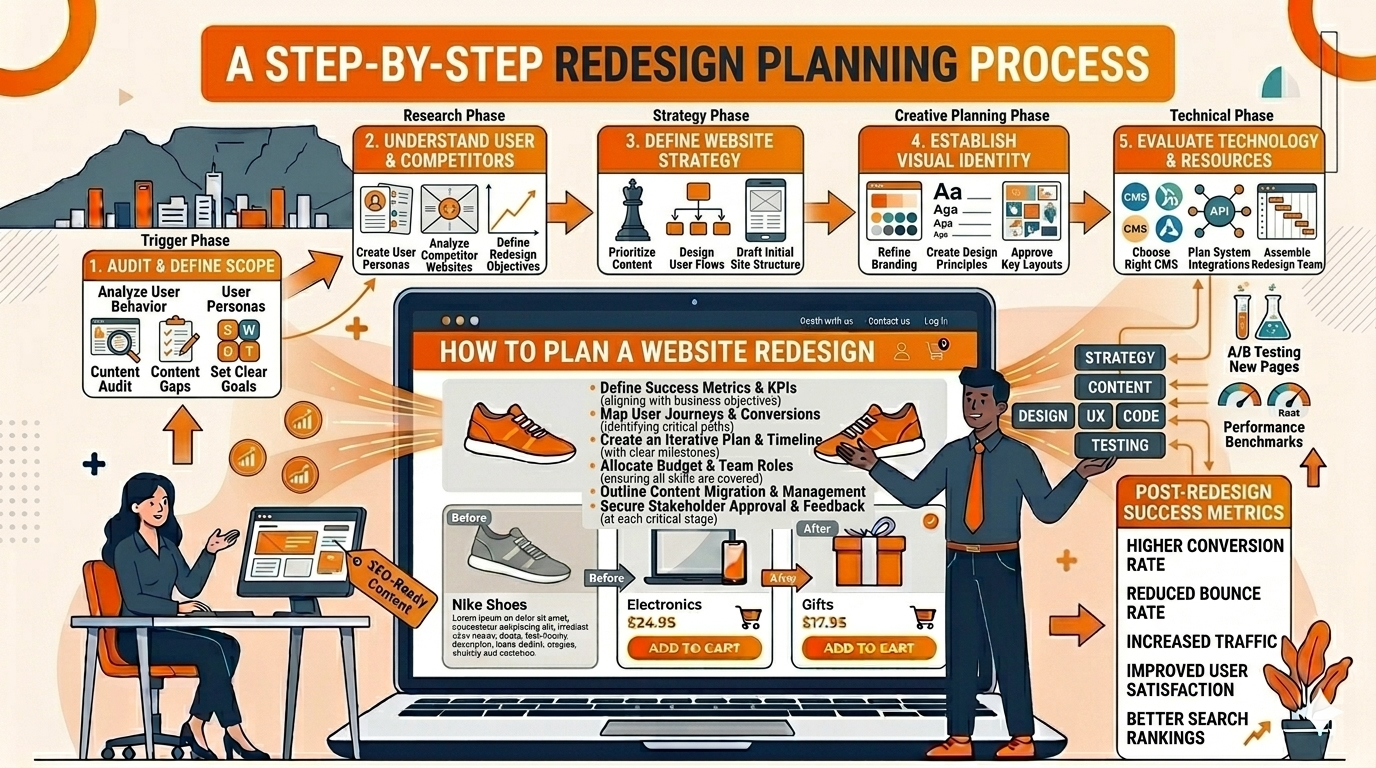
Planning a website redesign the right way saves you time, money, and frustration. This step-by-step guide walks South African business owners through everything they need to do before a single pixel is changed — so the end result actually grows their business.
Why Planning Your Website Redesign Matters
A website redesign is one of the most impactful investments a South African business can make — but only when it is done with a clear plan. Without proper planning, redesigns go over budget, miss deadlines, and end up looking great but delivering no real business results. Understanding how to plan a website redesign is what separates a website that grows your business from one that simply looks different.
Before you start thinking about colours, fonts, or layouts, you need to answer some fundamental questions about your business, your customers, and what you actually want your website to achieve. This guide gives you a clear, actionable plan to do exactly that.
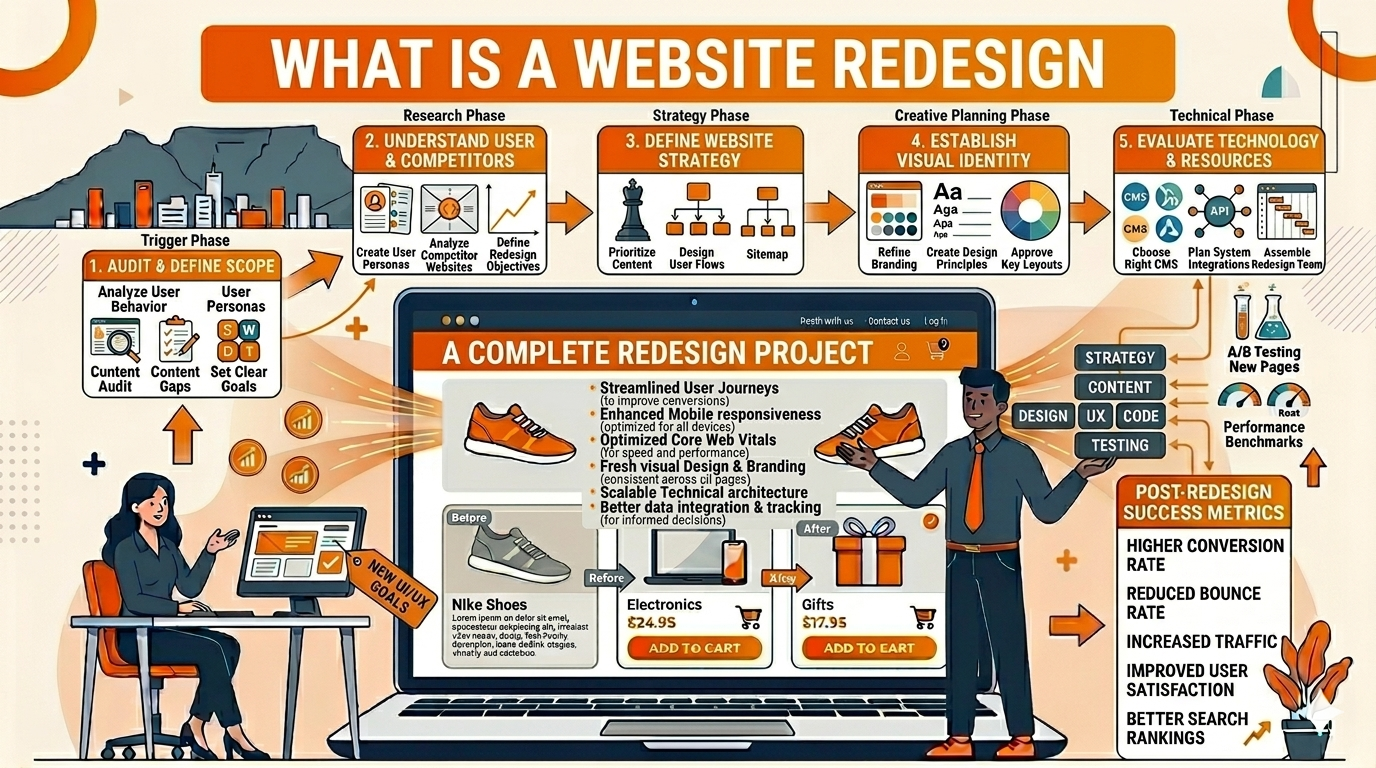
If you are not yet sure whether a redesign is right for you, start with our guide on what a website redesign is and our article on why businesses choose to redesign their websites. Once you are ready to commit, this planning guide is your next step.
At 99Webiz, we start every website redesign project with a planning session — no design work begins until we fully understand your goals, your audience, and the results you need. Visit our website redesign service page to learn how we approach every project.
Step 1 — Define Your Redesign Goals Before Anything Else
The single most important thing you can do before starting a website redesign is to define exactly what you want the new website to achieve. Vague goals like “I want a better website” will not help you or your designer make good decisions. Specific, measurable goals will.
Examples of Clear Website Redesign Goals
- Increase the number of enquiry form submissions by 30% within three months of launch
- Rank on the first page of Google for three target keywords within six months
- Reduce the website bounce rate from 75% to below 50%
- Generate online sales directly through the website for the first time
- Make the website fully mobile-friendly so it works on any phone or tablet
- Reflect a rebrand — new name, new logo, new brand identity — across all web pages
Write your goals down and share them with whoever is doing your redesign. Every design and content decision should be tested against these goals: does this help us achieve what we set out to do?
If you cannot clearly explain what success looks like after your redesign, pause and work that out first. A redesign without defined goals is a redesign without direction — and that wastes your money.
Step 2 — Audit Your Current Website Before You Scrap It
One of the most common mistakes South African business owners make is scrapping their entire existing website without first understanding what is actually working. Before you redesign, conduct a thorough audit of your current site. You may be surprised to find that some pages are performing well — and those need to be protected, not replaced.
What to Check in Your Website Audit
Google Analytics — Traffic and Behaviour
Which pages get the most visits? Which pages have the highest bounce rate? Which pages lead to the most enquiries or sales? Use this data to decide what to keep, what to improve, and what to remove entirely.
Google Search Console — Rankings and Clicks
Which keywords are currently sending traffic to your site? Which pages rank on Google? Protect these pages during your redesign — keep their URLs the same where possible, and set up 301 redirects if URLs must change.
Page Speed and Mobile Performance
Run your current website through Google PageSpeed Insights. A score below 50 on mobile is a serious problem and should be one of the primary targets of your redesign. A slow website loses South African visitors before they even read a word.
Content Quality Review
Read every page on your current website as if you were a new visitor. Is the content clear? Does it explain what you do and why a customer should choose you? Does it have a clear call to action on every page? Be honest about what needs to be rewritten.
Step 3 — Get Clear on Who Your Target Audience Is
Your website is not for you — it is for your customers. One of the most valuable things you can do when planning a website redesign is to build a clear picture of exactly who your ideal customer is, what they care about, and what they need to see on your website before they will trust you enough to make contact or buy.
Questions to Answer About Your Target Audience
- How old are they, and where in South Africa are they based?
- Are they browsing on a phone or a desktop computer?
- What problem are they trying to solve when they land on your website?
- What objections or concerns would stop them from contacting you or buying?
- What would make them trust your business over a competitor?
- What language do they use when they search for your type of business on Google?
The answers to these questions shape every decision in your redesign — from the layout and imagery to the language used in your headings and the placement of your contact buttons.
Step 4 — Set a Realistic Budget for Your Redesign
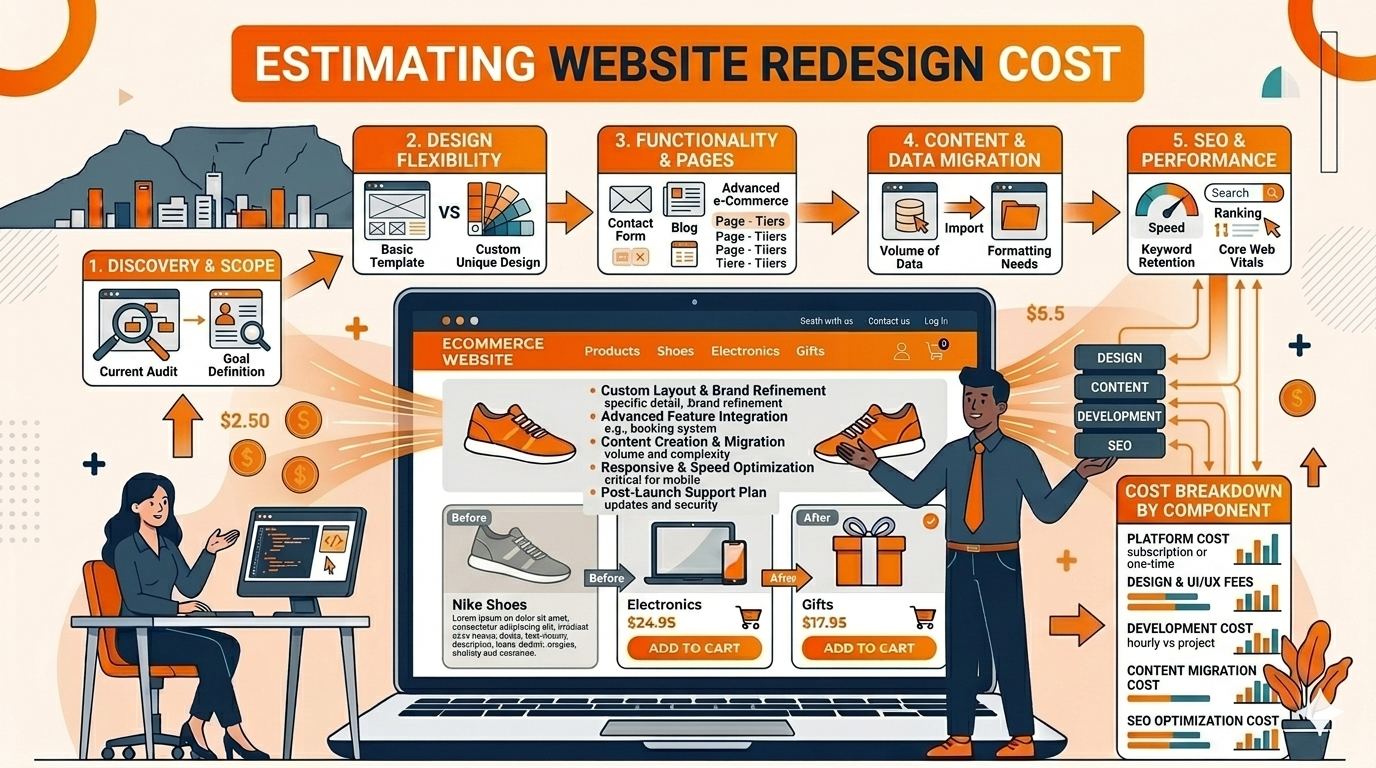
Understanding the cost of a website redesign in South Africa helps you plan realistically and avoid being caught off guard by quotes that are far higher — or suspiciously lower — than you expected. For a full breakdown of pricing, read our guide on how much a website redesign costs in South Africa.
How to Budget Smartly for a Website Redesign
- Get at least three quotes from different designers or agencies and compare what is included in each
- Ask specifically what is included — design, development, content writing, SEO setup, hosting, and ongoing support
- Factor in ongoing costs after launch — hosting, maintenance, and updates are recurring expenses
- If your full budget does not cover everything you want, prioritise the changes that will have the biggest impact first
- Consider a phased approach — launch a clean, fast, mobile-friendly site first, then add features over time
A cheap redesign that delivers no results costs you far more than a professional one. A poorly built website that ranks nowhere and converts no visitors is a wasted investment — no matter how little you paid for it. Focus on value, not just price.
Step 5 — Plan Your New Website Structure
Before any design work begins, you need a clear map of every page your new website will have and how those pages connect to each other. This is called your site architecture or site structure, and it determines how easy it is for both visitors and Google to navigate your website.
How to Build a Simple Site Structure for Your Redesign
List Every Page You Need
Start with the essentials — Home, About, Services or Products, Contact. Then add any additional pages your business needs, such as individual service pages, a blog, a gallery, a testimonials page, or a FAQ section. Do not add pages for the sake of it — every page should serve a clear purpose.
Group Related Pages Together
If you offer multiple services, create a parent Services page with individual child pages for each service. This hierarchy helps Google understand your site structure and helps visitors find what they are looking for without confusion.
Plan Your Internal Linking
Decide which pages should link to each other. A strong internal linking structure helps Google crawl your site more effectively and keeps visitors moving through your website instead of leaving after viewing a single page.
Plan Your Navigation Menu
Your main navigation should be simple and intuitive. Keep it to five to seven items at most. If your site has many pages, use dropdown menus sparingly — too many options overwhelm visitors and lead to decision paralysis.
Step 6 — Plan Your Content Strategy
Content is the most underestimated part of a website redesign. Many South African businesses focus entirely on the visual design and then scramble to fill pages with words at the last minute — resulting in thin, unconvincing content that fails to persuade visitors or rank on Google.
Content Planning Questions to Answer Before Your Redesign
- Which pages need to be completely rewritten from scratch?
- Which pages can be updated and improved rather than replaced?
- Do you have professional photos, or do you need new photography?
- Will you write the content yourself, or will your designer or a copywriter handle it?
- Do you want a blog as part of your redesigned website — and if so, who will write and publish posts consistently?
- Do all your pages have a clear, compelling call to action that tells the visitor exactly what to do next?
Not Sure Where to Start With Your Redesign?
Our team at 99Webiz helps South African businesses plan, design, and launch websites that actually perform — from the first strategy session to the day you go live.
Step 7 — Build Your SEO Plan Before You Touch the Design
This is the step that most South African business owners skip — and it is the one that costs them the most in the long run. A website redesign that ignores SEO can wipe out years of Google rankings overnight. A redesign that is planned with SEO in mind from day one will come out of the process ranking better than before.
SEO Planning Checklist for Your Website Redesign
- Document all existing URLs that currently receive organic traffic — these must be handled carefully
- Set up 301 redirects for any URLs that will change during the redesign — do not let Google lose track of your pages
- Research the keywords your target customers use to find businesses like yours on Google in South Africa
- Assign a primary keyword to every page of your new website before any content is written
- Plan your page titles and meta descriptions around your target keywords
- Ensure your redesigned website will load fast — page speed is a confirmed Google ranking factor
- Plan your heading structure — every page needs a clear H1 and logical H2 and H3 headings
- Plan ALT text for all images — descriptive, keyword-relevant ALT text helps your pages rank in Google Image Search
Do not wait until your redesign is live to think about SEO. The decisions you make during the planning stage — URL structure, page hierarchy, keyword targeting, and internal linking — have a far bigger impact on your Google rankings than any plugin you install after launch.
Step 8 — Choose the Right Designer or Agency for Your Redesign
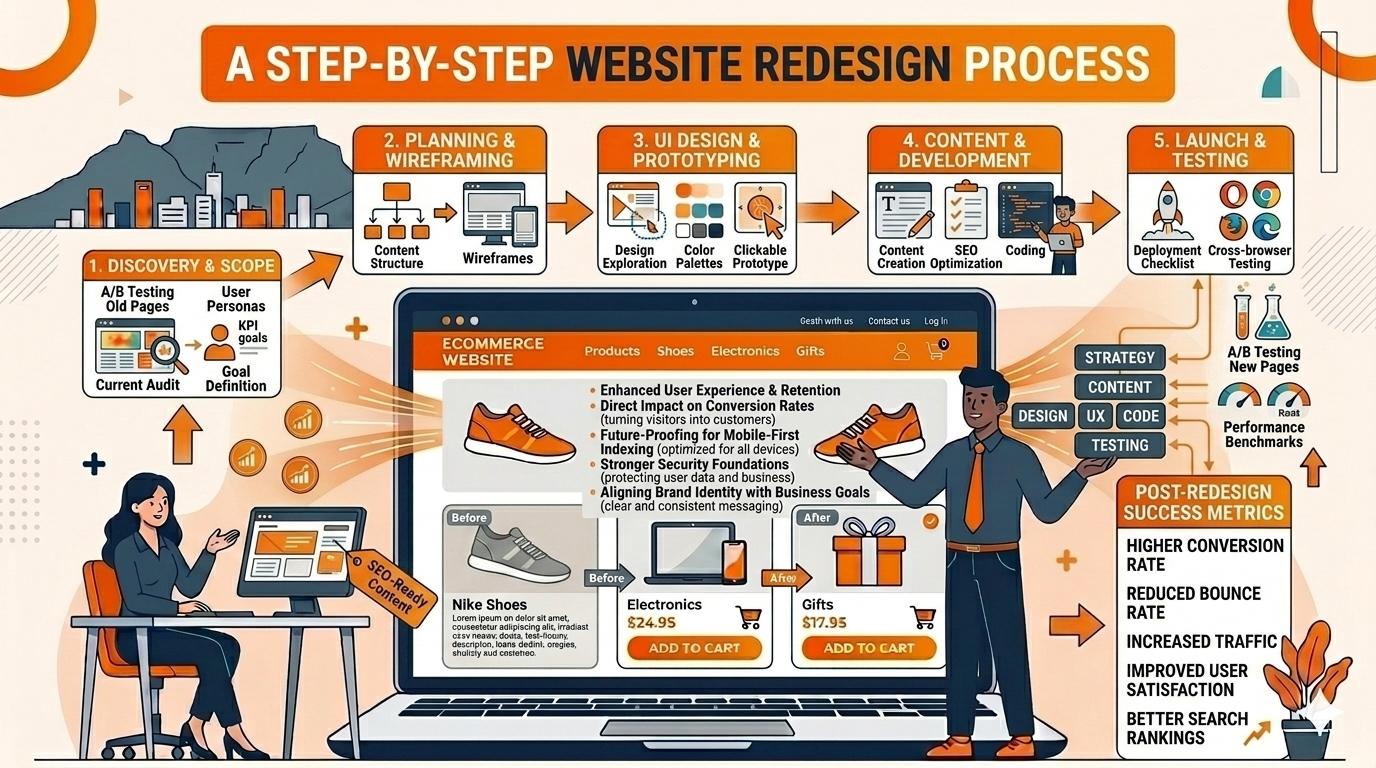
Who you choose to build your redesigned website is one of the most important decisions in this entire process. A talented, experienced designer or agency will guide you through the process, protect your SEO, and deliver a website that performs. The wrong choice will cost you money and set your business back. Our guide on how to do a website redesign covers the full execution process — but choosing the right partner comes first.
What to Look for When Choosing a Website Redesign Partner in South Africa
- A portfolio of real websites they have built — not just mockups or templates
- Experience working with South African businesses and an understanding of the local market
- A clear, transparent process — you should know exactly what will happen at every stage
- SEO knowledge — your designer should understand how to protect and improve your Google rankings
- Clear communication — they respond quickly, explain things clearly, and keep you informed
- Honest pricing with no hidden fees — get everything in writing before work begins
- Post-launch support — what happens if something breaks or you need a change after the site goes live?
Step 9 — Set a Realistic Timeline for Your Redesign
One of the most common frustrations in website redesign projects is a timeline that slips — usually because neither the client nor the designer planned it properly from the start. Knowing how often you should redesign your website helps you plan ahead, but once you commit to a project, setting a clear timeline keeps everything on track.
Realistic Website Redesign Timelines for South African Businesses
- Simple five to ten page brochure website: three to five weeks from kickoff to launch
- Medium business website with blog and multiple service pages: five to eight weeks
- Ecommerce website with product catalogue and payment gateway: six to twelve weeks
- Large or complex website with custom functionality: three to six months
Your timeline is only as realistic as your content delivery. The biggest cause of delays in website redesign projects is clients who are slow to provide written content, photos, and feedback. Build that into your plan from the start and assign someone on your team to be responsible for delivering content on time.
Avoid launching a new website in the middle of your busiest trading period. Plan your redesign so that launch happens during a quieter time — giving you space to test, adjust, and make any post-launch improvements without the pressure of peak season traffic.
Ready to Start Planning Your Website Redesign?
At 99Webiz, we guide South African businesses through every step of the redesign process — from the initial planning session to launch day and beyond. Let us help you build a website that works as hard as you do.
- Define clear, measurable goals before any design work begins — vague goals lead to poor results
- Audit your existing website first — protect pages that are already ranking and converting
- Build a detailed picture of your target audience — your redesign should speak directly to them
- Set a realistic budget and get itemised quotes — cheap redesigns often deliver no real business value
- Plan your site structure before design begins — a clear hierarchy helps both visitors and Google
- Invest in your content strategy — great design with weak content will not convert visitors into customers
- Build your SEO plan before you touch the design — protecting your rankings must be part of the plan from day one
- Choose a designer or agency with a proven portfolio, SEO knowledge, and transparent pricing
- Set a realistic timeline and take responsibility for delivering content on time to avoid delays