How Does Local SEO Work? A Plain-English Explanation for South African Business Owners
You have heard that local SEO can help your business get found on Google — but how does it actually work? This guide breaks down exactly how local SEO works, what Google looks at when deciding which businesses to show, and what you need to do to start ranking in your area.
What Is Local SEO and Why Does It Matter?
Local SEO is the process of optimising your business’s online presence so that Google shows it to people searching for services or products in your specific geographic area. When someone in Durban types “plumber near me” or “accountant in Johannesburg,” Google uses local SEO signals to decide which businesses appear at the top of the results — and in what order.
For South African businesses that serve a local area — whether that is a single city, a suburb, or a region — local SEO is one of the most powerful and cost-effective forms of digital marketing available. Unlike paid advertising where you stop appearing the moment you stop paying, local SEO builds lasting visibility that brings in enquiries month after month.
Before going deeper, it helps to understand what local SEO is and how it differs from general SEO. Once you understand the fundamentals, this guide will show you exactly how the mechanics work under the hood.
At 99Webiz, our local SEO services start from just R799 per month — a fully managed strategy that handles every ranking factor covered in this guide, so you can focus on running your business.
1 – How Google Decides Which Local Businesses to Show
When someone performs a local search — whether they type a location like “Cape Town” or simply use a phrase like “near me” — Google’s algorithm analyses hundreds of signals to decide which businesses are the most relevant, trustworthy, and geographically appropriate to show that person.
Google does not just look at your website in isolation. It looks at your entire online presence — your Google Business Profile, your website, your reviews, your business listings across the web, and how other websites reference your business. All of these signals combine to determine your local search ranking.
What Google Is Trying to Do
Google’s goal is simple: show the most useful, relevant, and trustworthy result for every search query. In a local context, this means showing businesses that are:
- Physically located in or near the searcher’s area
- Offering the exact service or product the searcher is looking for
- Trusted and well-reviewed by real customers
- Active, up-to-date, and clearly established as legitimate businesses
Every local SEO strategy is essentially an effort to send Google as many of these positive signals as possible — consistently, across every platform where your business has a presence.
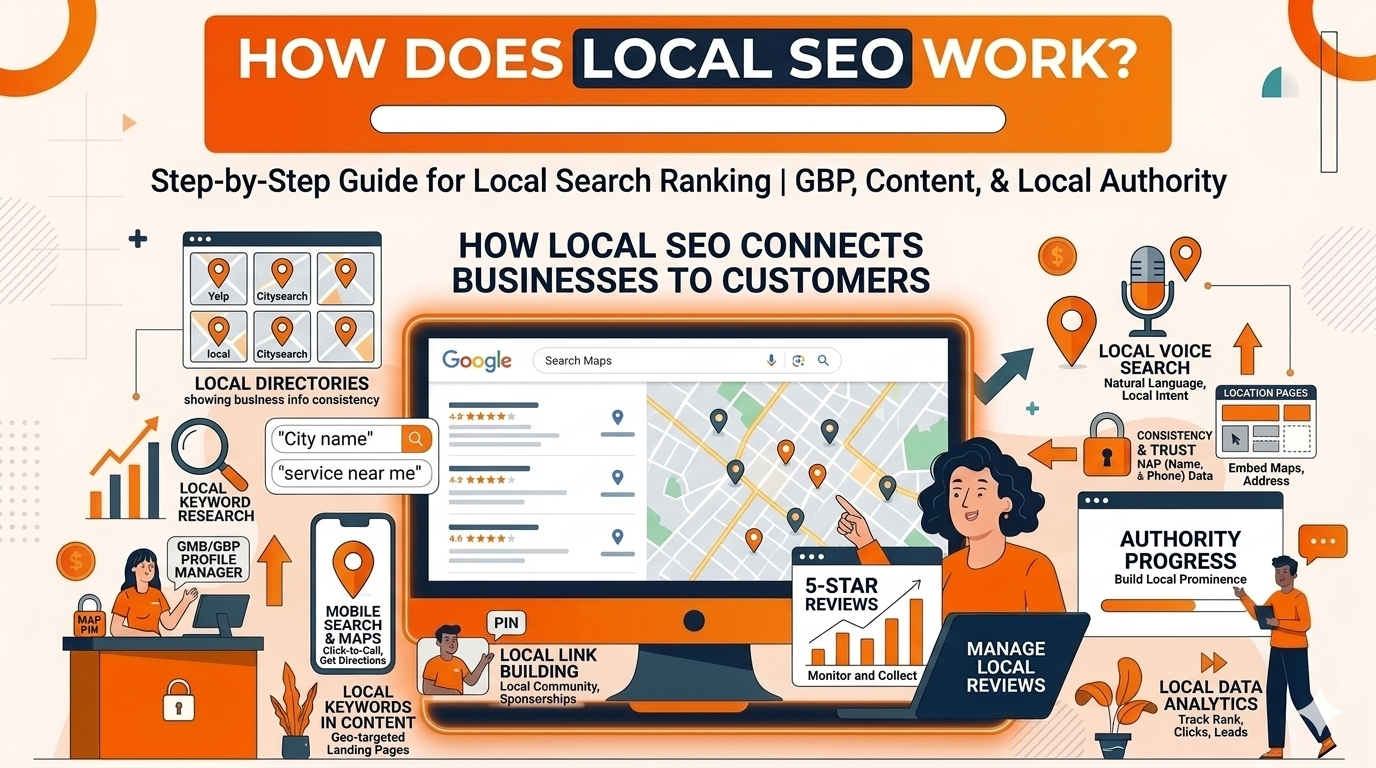
2 – The Google Map Pack: What It Is and How to Get In
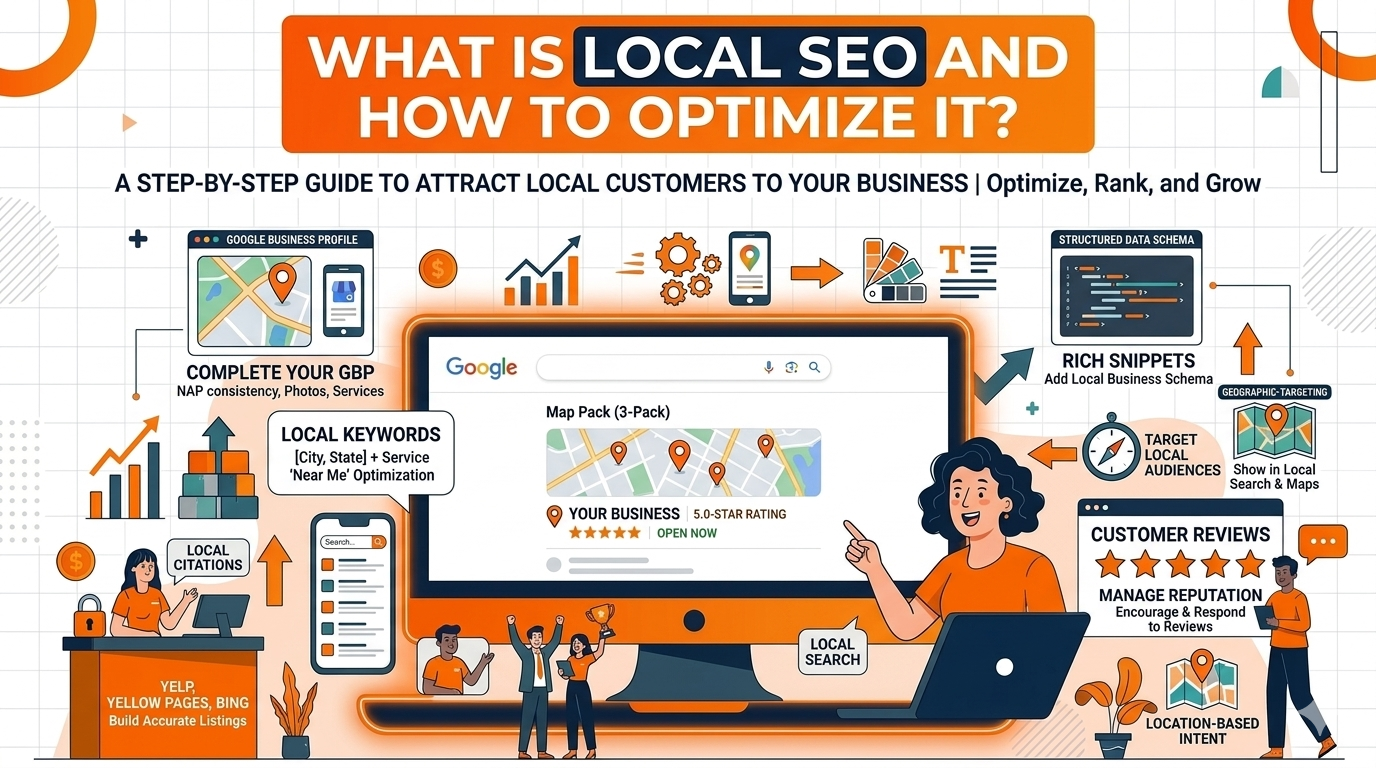
When you search for a local service on Google, you will almost always see a block of three business listings appear near the top of the page — above the regular website results. This block is called the Google Map Pack (also known as the Local Pack or the 3-Pack). It shows the business name, star rating, address, phone number, hours, and a link to the Google Maps listing.
Appearing in the Map Pack is the holy grail of local SEO. Studies consistently show that the Map Pack receives the majority of clicks for local searches — often more than 40% of all clicks go to these three listings. If your business is not in the Map Pack, you are missing the largest share of potential customers from every local search in your area.
What Powers the Google Map Pack
- Your Google Business Profile — you must have a verified, complete profile to appear in the Map Pack at all
- Your proximity to the searcher — Google shows businesses that are physically closest to where the search is happening
- Your relevance — how closely your business category, description, and services match what the person searched for
- Your prominence — how well-known and trusted Google considers your business to be, based on reviews, citations, and backlinks
The Map Pack and the organic website results below it are powered by different algorithms. A strong local SEO strategy targets both — optimising your Google Business Profile for the Map Pack, and optimising your website pages for the organic results directly below it. Appearing in both positions dramatically increases your visibility and click-through rate.
3 – The Three Core Local SEO Ranking Factors
Google has publicly confirmed that its local search algorithm is built around three primary ranking factors: Relevance, Distance, and Prominence. Understanding what each of these means — and how to influence them — is the foundation of any effective local SEO strategy.
Relevance — Does Your Business Match What Was Searched?
Relevance is about how well your business profile and website match the intent of the search query. If someone searches “emergency electrician Durban,” Google will favour businesses whose Google Business Profile category is “Electrician,” whose business description mentions emergency electrical services, and whose website has content specifically about emergency electrical work in Durban. The more precisely your online presence matches a search query, the more relevant Google considers you.
Distance — How Close Are You to the Searcher?
Distance refers to how far your business is from the location mentioned in the search query — or from the searcher’s current location if no location was specified. Google uses the physical address on your Google Business Profile to calculate distance. This is one factor you cannot directly change — your business is where it is. However, by optimising your relevance and prominence, you can still outrank businesses that are physically closer but less well-optimised.
Prominence — How Well-Known and Trusted Is Your Business?
Prominence is about how established and authoritative your business appears online. Google measures prominence through the number and quality of your Google reviews, the authority of your website, the number of other websites that reference your business (citations and backlinks), and how active and complete your online presence is. This is the factor you have the most control over — and where most of your local SEO effort should be focused.
4 – How Your Google Business Profile Affects Rankings
Your Google Business Profile (GBP) is the single most influential factor in your local SEO performance. It is the data source that powers your Map Pack listing, your Google Maps presence, your Knowledge Panel on the right side of search results, and the information Google shows when someone searches directly for your business name.
A fully optimised Google Business Profile tells Google — and potential customers — everything they need to know about your business: what you do, where you are, when you are open, what customers think of you, and what you look like. The more complete and active your profile, the more signals you send to Google that you are a legitimate, trustworthy, relevant local business.
Key Google Business Profile Optimisation Points
- Business category — your primary category is the most important field in your entire profile; choose the most specific, accurate category available
- Business description — write a keyword-rich description that naturally includes your primary services and the areas you serve
- Services and products — list every service individually with descriptions; Google uses this data to match your profile to relevant searches
- Photos — profiles with more high-quality photos receive significantly more views and clicks; upload at least 15 to 20 photos
- Google Posts — publishing regular posts (offers, updates, events) signals to Google that your profile is active and up to date
- Q&A section — add your own questions and answers to pre-populate this section with helpful, keyword-rich content
- Attributes — enable all relevant attributes (e.g. “women-led,” “Black-owned,” “serves Durban”) to help Google match your profile to more specific searches
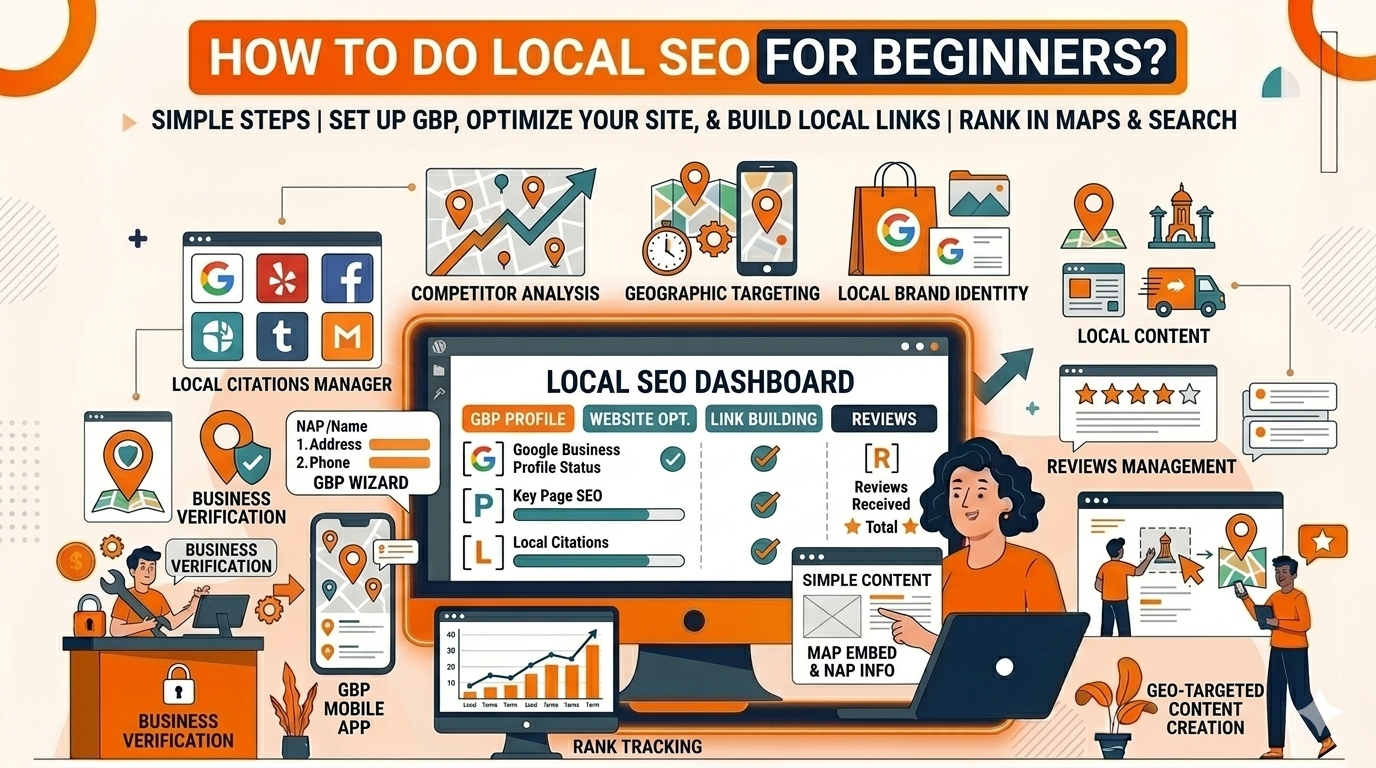
Your business name, address, and phone number on your Google Business Profile must match exactly what appears on your website and across every other online listing. Even small differences — like “Road” vs “Rd” — can undermine your local SEO signals. Learn more about how to fix this in our guide on how to do local SEO.
5 – The Role Your Website Plays in Local SEO
While your Google Business Profile powers your Map Pack ranking, your website is the foundation of your organic local SEO — the standard blue-link search results that appear below the Map Pack. A well-optimised website with strong local signals can rank your business in both the Map Pack and the organic results simultaneously, giving you double the visibility on a single search results page.
Your website also reinforces and validates everything in your Google Business Profile. When Google sees that your website clearly confirms your business name, location, services, and contact details — and that your site is fast, mobile-friendly, and technically sound — it gains more confidence in your business and rewards you with better local rankings.
How to Make Your Website Work for Local SEO
- Location-specific title tags and meta descriptions — every page should include your city and primary service in its title tag
- Local landing pages — if you serve multiple areas, create a dedicated optimised page for each city or suburb you target
- NAP in the footer — display your full business name, address, and phone number in the footer of every page on your website
- LocalBusiness schema markup — add structured data so Google can read your business details in a machine-readable format
- Embedded Google Map — embed your Google Maps location on your Contact page to reinforce your geographic signals
- Fast load speed — Google penalises slow websites in rankings; a fast site is essential for both SEO and user experience
- Mobile-friendly design — the majority of local searches happen on mobile devices; a non-mobile-friendly site will not rank well locally
If your website is built on WordPress, you have an excellent foundation for local SEO. Read our guide on what WordPress website design involves to understand how your site structure supports your local search performance.
Get a Local SEO Strategy That Actually Works
Our local SEO service starts from R799/month and covers everything — Google Business Profile, website optimisation, citations, reviews, and monthly reporting.
6 – How Reviews and Trust Signals Work in Local SEO
Google reviews are one of the most powerful local SEO ranking signals available — and they are one of the few signals that also directly influence whether a customer chooses your business over a competitor. The number of reviews you have, your average star rating, how recent your reviews are, and how consistently you respond to them all feed into Google’s assessment of your business’s prominence and trustworthiness.
How Reviews Influence Your Local Rankings
- Review quantity — more reviews generally means better rankings, all else being equal; a business with 80 reviews will typically outrank one with 8 reviews
- Review recency — Google values fresh reviews; a business that receives reviews consistently over time ranks better than one that got 50 reviews two years ago and nothing since
- Review rating — your average star rating affects both your ranking and your click-through rate; aim to maintain a rating above 4.0
- Review responses — responding to reviews signals that your business is active and engaged; Google’s own documentation recommends responding to all reviews
- Keywords in reviews — when customers naturally mention your services and location in their reviews (“amazing plumber in Durban”), these keywords reinforce your relevance signals
Purchasing fake Google reviews is against Google’s policies and can result in your Google Business Profile being suspended or permanently removed. Build your reviews organically by asking every genuinely satisfied customer to share their experience. It takes more time but it is the only sustainable approach.
7 – Citations and Backlinks: Building Local Authority
Two of the most important external signals in local SEO are citations and backlinks. Both tell Google that your business is real, established, and trusted — but they work in slightly different ways.
What Are Local Citations?
A citation is any online mention of your business name, address, and phone number (NAP) — even if there is no link back to your website. Citations appear on business directories, social media profiles, review platforms, and local websites. They serve as independent verification of your business’s existence and location. The more consistent, accurate citations your business has across reputable South African platforms, the stronger your local authority signal becomes.
- Google Business Profile (the most important citation of all)
- Yelp South Africa, Yellow Pages SA, Brabys, Hotfrog SA, Cylex SA
- Facebook Business Page and LinkedIn Company Page
- Industry-specific directories relevant to your business sector
What Are Local Backlinks?
A backlink is a clickable link from another website pointing directly to yours. Backlinks are a major general SEO ranking factor — and in local SEO, links from other South African websites and locally relevant sources carry extra weight. A link from a Durban business association, a local news site, or a complementary local business tells Google that your business is genuinely embedded in the local community.
- Local chamber of commerce and business association websites
- South African news sites and local blogs that mention your business
- Complementary local businesses that link to your site as a recommended partner
- Suppliers and clients who feature you on their website
- Sponsorships of local events, charities, or sports teams that include a link to your website
Want to understand the full picture of what is involved in ranking locally? Read our complete guide on how to rank in local SEO for a detailed breakdown of every strategy that moves the needle.
8 – How Long Does Local SEO Take to Work?
This is one of the most common questions South African business owners ask when they start exploring local SEO — and the honest answer is that it depends on several factors: your industry, how competitive your local market is, how your current online presence looks, and how consistently the work is done.
Local SEO is not instant. It is a compounding, long-term strategy — but it typically shows results much faster than general SEO because the competition in a local area is far smaller than in a national or global market.
Weeks 1 to 4 — Foundation and Setup
In the first month, the work is foundational: optimising your Google Business Profile, fixing your website’s on-page SEO, ensuring NAP consistency, and submitting to the most important South African directories. You may not see dramatic ranking changes yet, but you are building the infrastructure that everything else depends on.
Months 2 to 3 — Early Signals and Movement
By months two and three, you should start seeing your Google Business Profile ranking for some of your target keywords, your website appearing in search results for local queries, and your first citation signals beginning to register with Google. If you are actively collecting reviews during this period, your Map Pack visibility will begin to improve noticeably.
Months 4 to 6 — Consistent Growth
This is where local SEO really starts to compound. With consistent work — ongoing review collection, regular Google Business Profile posts, continued citation building, and fresh website content — you should see meaningful ranking improvements for your primary keywords, increased profile views, more calls directly from Google, and a measurable increase in website traffic from local searches.
Month 6 and Beyond — Sustained Results
Beyond six months of consistent local SEO work, most South African businesses in low-to-medium competitive markets will be ranking in the Google Map Pack for their primary keywords and appearing in the top organic results for their key local search terms. Unlike paid advertising, these rankings do not disappear the moment you stop paying — they are assets that continue to deliver value month after month.
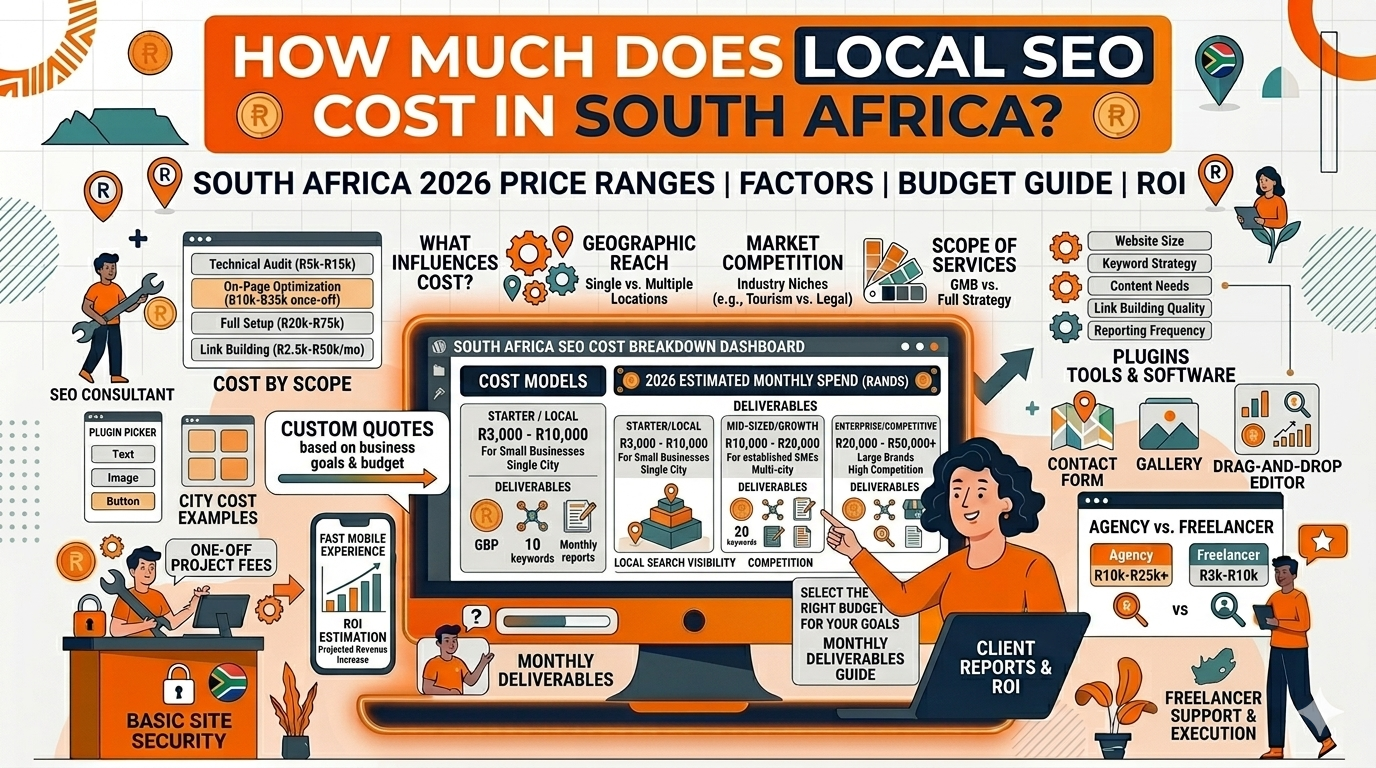
Wondering what investment is involved? Read our transparent breakdown of how much local SEO costs in South Africa so you know exactly what to budget and what results to expect at different price points.
Start Getting Found Locally on Google
Our local SEO packages start from R799/month — fully managed local SEO for South African businesses, with transparent monthly reporting so you can track every improvement.
- Local SEO works by sending Google signals that prove your business is relevant, nearby, and trustworthy for local search queries
- Google’s local algorithm is built on three core factors: Relevance, Distance, and Prominence
- The Google Map Pack receives the most clicks on any local search results page — appearing in it is the primary goal of local SEO
- Your Google Business Profile is the single most important local SEO asset — it must be fully optimised and kept active
- Your website reinforces your local signals — it must be fast, mobile-friendly, and optimised with local keywords and structured data
- Google reviews directly influence your Map Pack ranking — quantity, recency, rating, and responses all matter
- Local citations confirm your business exists and is legitimate — build them on reputable South African directories
- Local backlinks from South African websites build your authority and improve both local and organic rankings
- Local SEO takes 3 to 6 months to show strong results — but the rankings it builds are long-lasting assets
- 99Webiz local SEO packages start from R799/month — fully managed with monthly reporting included